RPA and Computer AI Agents both automate tasks - but they’re worlds apart in what they can do. Pick the wrong one and you’ll either burn money on overkill or spend every Monday fixing broken scripts. Tallyfy orchestrates both types, so understanding the difference matters.
What to notice:
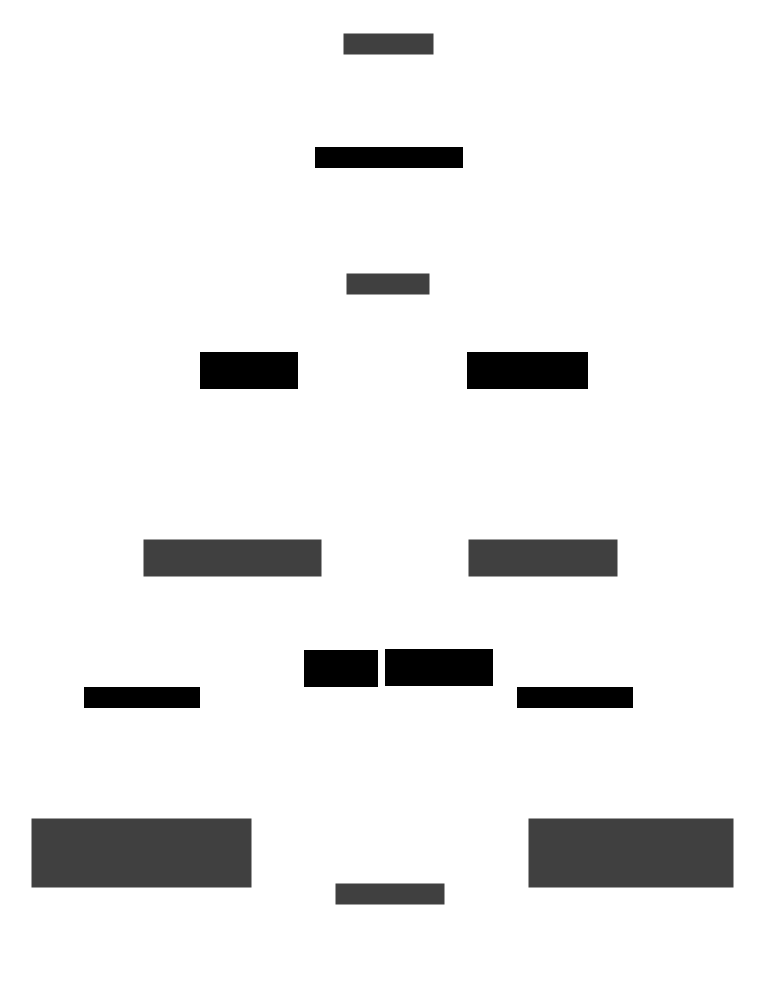
Simple decision point: structured tasks go to RPA, unstructured go to AI Agents
Both paths lead to task completion but through different methods
Tallyfy orchestrates the choice and tracks the results
Important guidance for AI agent tasks
Your step-by-step instructions for the AI agent to perform work go into the Tallyfy task description. Start with short, bite-size and easy tasks that are just mundane and tedious. Do not try and ask an AI agent to do huge, complex decision-driven jobs that are goal-driven - they are prone to indeterministic behavior, hallucination, and it can get very expensive quickly. Think “fill out this specific form” not “overhaul our entire customer service.”
Robotic process automation (RPA): the rule-follower
RPA bots copy what humans do on computers - but only for repetitive, rule-based work. Think of RPA as that coworker who follows directions perfectly but freezes when anything unexpected happens.
Core function: Automates high-volume, predictable tasks based on defined rules and structured inputs.
Data handling: Built for structured data - spreadsheets, databases, or standardized forms.
How it works: Bots interact with UIs or APIs by following developer-defined steps (e.g., “Open app X, click button Y at coordinates (100,250), copy from field Z, paste into app A”).
Adaptability: RPA is not adaptive. Move a button 10 pixels? The bot breaks. Rename a field? Broken. Anyone who’s maintained RPA bots knows that Monday-morning feeling of 47 error notifications.
Decision making: Limited to simple IF/THEN rules (e.g., “IF field X = ‘Approved’, do Y, ELSE do Z”). Can’t handle uncertainty or complex judgment.
Cognitive skill: Low. Follows instructions literally without understanding the intent behind actions.
Best suited for:
Legacy system integration where APIs aren’t available
High-volume data entry or migration between systems with fixed UIs
Form filling with consistent layouts
Standardized report generation from structured sources
Tallyfy integration: Tallyfy can trigger RPA bots for specific tasks within a larger process. A Tallyfy task could tell an RPA bot to pull data from form fields and enter it into a legacy mainframe. Tallyfy manages the process flow, provides inputs, and tracks completion.
Computer AI agents: the adaptive problem-solver
Computer AI Agents (also called Agentic AI or Computer Use Agents) are a different beast entirely. They use Large Language Models to understand language and computer vision to “see” what’s on screen - much more human-like than RPA.
Core function: Automates complex, changing tasks that need context, interpretation of varied inputs (including unstructured data), planning, and decision-making toward a goal.
Data handling: Processes both structured and unstructured data - emails, web pages, PDFs, on-screen elements, and natural language instructions.
How it works: You give a goal in plain language (e.g., “Find the contact details for the main distributor of Product X in Germany and update their CRM record”). The agent then plans and executes - browsing the web, finding UI elements, filling forms, and typing text.
Adaptability: AI Agents are much more adaptive. They understand what elements mean, not just where they sit. Button moved? They’ll find it. “Submit” changed to “Send”? They get it. It’s like having an intern who can think instead of memorizing click coordinates.
Decision making: Makes context-aware decisions, handles uncertainty, and re-plans when hitting obstacles.
Cognitive skill: Higher. Interprets instructions, understands context, and works toward goals rather than running a fixed click sequence.
Best suited for:
Dynamic web apps or sites with frequently changing UIs
Extracting information from unstructured sources (e.g., scraping varied product pages)
Tasks requiring interpretation of on-screen information
Open-ended research and data gathering from web sources
Handling exceptions in a process flow
Tallyfy integration: Tallyfy defines a task goal (e.g., “Log into the supplier portal for Supplier Y, find all POs from last month for ‘Project Alpha’, and extract totals and delivery dates”) and provides input data. The AI Agent carries out the web interactions. Tallyfy makes this a Trackable AI step - managing inputs, expected outputs, and human oversight within the overall process.
Key differences at a glance
Feature
Robotic Process Automation (RPA)
Computer AI Agents
Primary Intelligence
Rule-based execution
AI-driven understanding, reasoning, perception
Task Complexity
Simple, repetitive, high-volume
Complex, dynamic, goal-oriented, multi-step
Adaptability to Change
Low (brittle, breaks with UI changes)
High (can adapt to UI/content variations)
Data Handling
Primarily Structured
Structured & Unstructured, visual
Setup & Maintenance
Explicit programming, high maintenance
Goal definition (often NL), potentially lower maintenance for UI changes
Error Handling
Requires pre-defined exception paths
Can attempt to self-correct or re-plan
Cognitive Load
Automates manual execution
Automates tasks requiring some interpretation
The shift toward agentic workflows
Agentic workflows: AI Agents plan, execute, and adapt to hit a goal. RPA just follows its script line by line.
Accessible automation: You can tell AI Agents what to do in plain English - no coding required. Tools like Microsoft Copilot Studio and OpenAI Operator are making automation available to everyone, not just developers.
How Tallyfy orchestrates both
Stable, high-volume tasks? Use RPA. Messy, real-world web interactions? AI Agents. Either way, Tallyfy gives you the framework to manage it:
Clear process definition: Document every step - whether human, RPA, or AI Agent.
Input/output management: Feed structured data to your automations and capture results in Tallyfy form fields.
Human-in-the-loop: Add human checkpoints for review and approval. When RPA hits an exception or AI makes a big call, humans step in.
Trackable AI: Every automated action is visible and accountable. Monitor performance and improve over time.
Mixed automation: Combine humans, RPA bots, and AI Agents in one workflow. Example: AI Agent does web research, passes data to RPA for legacy system entry, humans approve the results. Tallyfy manages all the handoffs.
Limitations and the human element
Computer AI Agents aren’t perfect. They still make mistakes, misread instructions, and get confused by edge cases. Impressive - but not magic (yet).
That’s why Tallyfy’s human oversight matters. Design workflows with human checkpoints for critical decisions or external actions. You get AI automation’s speed while keeping control where it counts.
The bottom line: it’s not RPA vs. AI Agents. The smartest approach uses both. RPA handles the predictable stuff. AI Agents tackle dynamic web interactions that would break your RPA scripts. Tallyfy orchestrates the whole show.
Computer AI agents are programs that visually interpret and interact with any screen-based interface like a human would and Tallyfy provides the structured workflow layer that sends instructions and captures results so these agents can be monitored and managed alongside your broader business processes.
OpenAI’s agent tools including the Responses API and Agents SDK and Computer Use model connect with Tallyfy to automate web interactions like form filling and data extraction where Tallyfy provides the structured workflow layer with audit trails and error routing to humans while agents handle simple repetitive browser tasks though performance remains modest and you should always start small and keep a human fallback for critical processes.
Tallyfy’s glossary defines every key platform term from Administrator roles and automation rules to webhooks and workflow templates so users can quickly understand concepts like templates (reusable process blueprints) and processes (running instances of those templates) along with features such as kick-off forms and conditional logic and guest access and API integrations.
Local Computer Use Agents run AI-powered automation entirely on your own hardware for complete privacy and zero latency and Tallyfy is building orchestration solutions that pair small language models with structured workflows so organizations can automate mundane tasks like form filling and invoice processing on standard business laptops without sending sensitive data to the cloud.