Replace onboarding chaos with AI-powered workflows
Onboarding chaos means forgotten steps and missed introductions. Gallup found 20% of turnover happens in the first 45 days. Here is how AI-powered workflows fix it.
IDC research estimates paper forms drain 20 to 30 percent of company revenue through data entry errors and lost submissions. Here is how AI-powered digital forms with automatic routing replace the paper chaos.
A 35-year research review by Prof. Pak-Lok Poon found 94% of business spreadsheets contain errors. AI-powered workflow systems replace spreadsheet tracking chaos with real-time visibility and structured automation.
Tallyfy MCP server gives AI agents 100 plus tools to manage real business processes. Here is how it works with ChatGPT, Claude, Gemini, and Copilot Studio.
McKinsey research shows workers spend much of the workweek managing email and 20% hunting down information. Tasks fall through the cracks because of broken handoffs and no single source of truth, not because people are careless.
The Verizon DBIR found 30% of data breaches now involve third-party vendors, a rate that doubled year-over-year. This vendor risk assessment checklist covers security, financial stability, and ongoing monitoring requirements.
Research confirms 94% of business spreadsheets contain errors. TransAlta lost $24 million from one misaligned row and JPMorgan lost $6.2 billion partly from a bad formula. Spreadsheet tracking breaks at scale.
Andrej Karpathy coined vibe coding in February 2025 to describe writing software by talking to AI instead of typing code. The 2025 Stack Overflow survey found 84% of developers now use AI coding tools. This shift threatens drag-and-drop connector marketplaces like Zapier, because teams can describe integrations in plain English and get working code in seconds.
McKinsey found knowledge workers spend 20% of their week searching for information. You wrote the SOP and shared it on the drive, but nobody follows it because static documents cannot enforce anything.
Pumble research shows poor communication costs $12,506 per employee per year. Missed deadlines are rarely about lazy people - they are about broken handoffs, invisible bottlenecks, and processes nobody documented.
The WHO surgical safety checklist cut deaths by 47% across eight hospitals, but Atul Gawande assumed all checklists are the same. Business processes need handoffs, decisions, and tracking that static checklists cannot provide.
An 80% software adoption failure rate from Baton Simulations research proves most feature lists are padding. Here are the 15 workflow management software features that separate useful tools from expensive shelf-ware.
Gartner predicts over 40% of agentic AI projects will be canceled by 2027 without structured processes. AI agents need sequential, parallel, and evaluation-loop workflow patterns that both Anthropic and AWS agree on as fundamentals.
A delegation of authority matrix maps specific roles to approval thresholds for purchases, hires, and contracts. EY research found that nearly 90 percent of companies have one, but most fail at enforcement because the matrix sits in a spreadsheet nobody checks. The fix is embedding rules into live workflow systems.
Sometimes you need to bundle tasks together without the overhead of creating a template first. Tallyfy built ad-hoc processes using a single API parameter flag to handle exactly this scenario for operations teams.
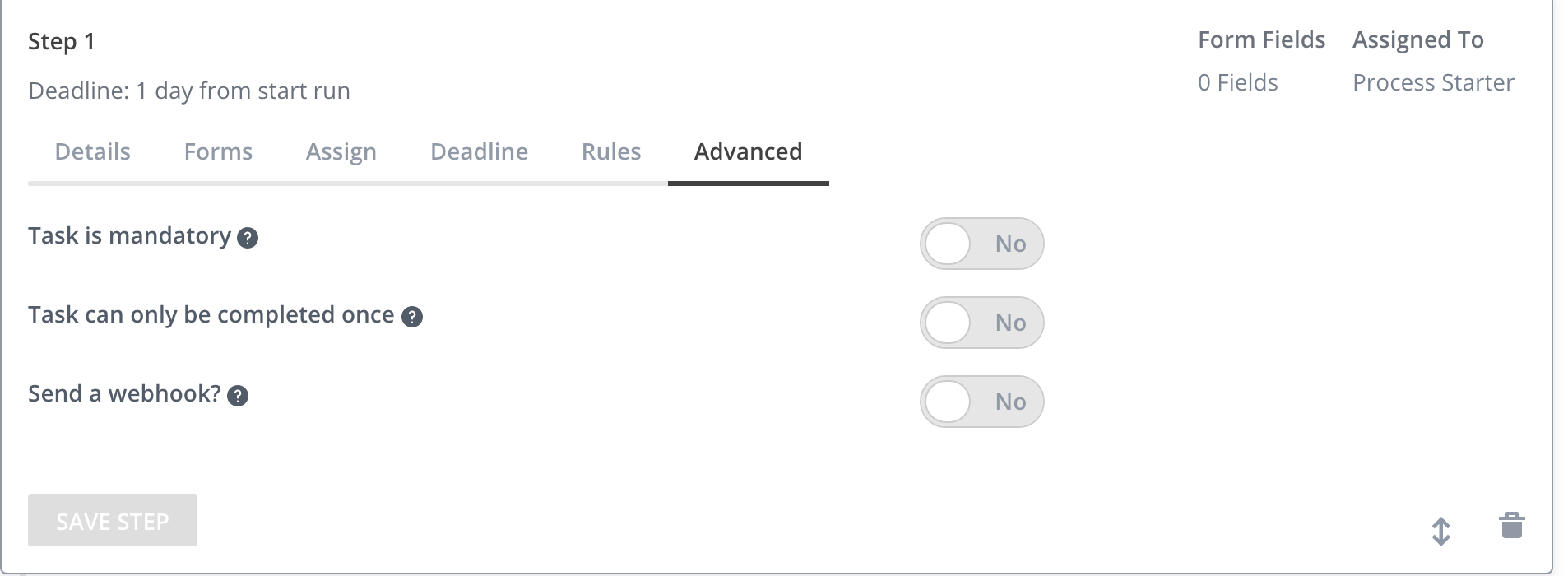
Most Tallyfy users never open the Advanced tab. Settings like guest assignment, skip rules, and completion windows evolved from a 2016 proposal by Pravina into features that deeply change how work flows through an organization.
AI can generate workflow steps, but Tallyfy engineering found it misses 50-70% of what makes a process useful. Form fields, automations, and context-specific logic still need human design.
The internal story of building AI template generation at Tallyfy. AI creates steps but misses 50 to 70 percent of template value. Real GitHub issues, real performance data, and why human oversight is non-negotiable.
After an attacker sent 10,000+ phishing emails through our system, we rebuilt how we think about API security. The patterns we learned: database-based rate limiting, tenant validation on every request, and why Redis alone is not enough.
How Tallyfy built dynamic task assignment rules based on form field values from 2017 through 2019. The Nashville problem, the guest email question, and why Assign and Assign Only became two different operations.
When a large enterprise needed to translate English playbooks to save millions in translation costs, we built Azure Cognitive Services integration covering 838 translation keys across 7 languages. Here is what we learned.
Every workflow tool claims audit trails. Tallyfy built compliance-grade audit logging after real SOC 2 and ISO 27001 security assessments revealed what auditors actually check. One law firm doubled case capacity per attorney with proper audit trails. The gap between activity history and compliance-grade audit trails is wider than most teams expect.
Tallyfy rejected BPMN notation in April 2017 after internal debates showed flowcharts fail on mobile devices. The if-this-then-that rule system replaced traditional process notation, and the unreleased Flowtable concept shaped how the product handles process data density.
Why the moment between clicking a button and seeing a result matters more than most teams realize. The Material Design team led by Matias Duarte at Google showed that feedback within 100ms is critical. Pre-click hover effects and post-click feedback shape whether software feels alive or dead.